

Translational Research in Public Health
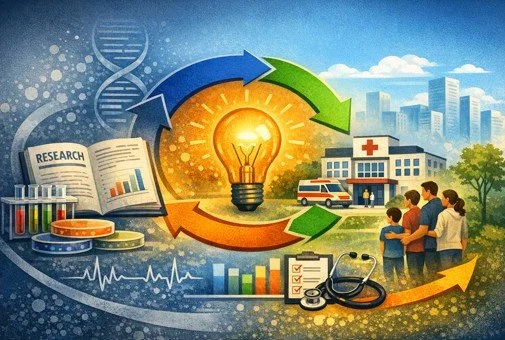
The Health-Within website is all about translating public health research into practice. In other words, it aims to ensuring that the work done by academic researchers is seen by practitioners, incorporated into their work and leads to benefits across society.
Towards this aim, the website focuses on ‘translational research’ and other academic work that looks at real world applications of scientific concepts. For example, you’ll find articles on how we can best utilise new scientific discoveries relating to GLP-1 medications for weight management, and how we can turn what we know about mental health into programmes that make a real difference in our communities.
What do we mean by “translational research”?
Translational research is commonly used to describe the connected set of activities that move knowledge from discovery through to real‑world benefits in practice, services, policy and, ultimately, population outcomes. The most well know forms of translational research come from biomedicine and pharmaceuticals.
An article by Fort et al (2017) provides a good overview of five key stages in translational research (T0 to T5). T0 encompasses foundational research, such as genome‑wide association studies, which feeds back into basic science and informs subsequent translational phases. T1 focuses on processes that translate basic scientific discoveries into early testing in humans. T2 involves demonstrating effectiveness in human studies and informing the development of clinical guidelines. T3 centres on implementation and dissemination research, while T4 examines population‑level outcomes and effectiveness.
The RE‑AIM Framework takes this process further and is particularly helpful for those of us in public health, who may be used to seeing well tested scientific technologies not live up to expectations when they are implemented in the real world. RE-AIM argues that public health impact depends not only on effectiveness but also on Reach, Adoption, Implementation, and Maintenance. Twenty years after the original RE-AIM was produced, a review expanded and adapted the Framework and advocate for key enhancements, such as the inclusion of qualitative research to better understand why scientific findings do, or do not, translate into real world benefits across society.
A final model to highlight that is relevant to this topic is the Knowledge-to-Action (KTA) Framework. This sets out two key components. The first is ‘knowledge creation’ which includes the production, synthesis and interpretation of knowledge. As knowledge moves through three stages (inquiry, synthesis, tools/products), it becomes more user-friendly. The second component is the ‘action cycle’ consisting of seven activities required for effective implementation of knowledge. These include adapting knowledge to the local context, assessing barriers and facilitators to its use, the involvement of stakeholders, and tailoring knowledge to the needs of people who are going to use it.
Translational Research in Public Health
While the models described above are important, Ogilvie et al. (2009) argue that a linear, basic-to-applied, 'translational medicine' paradigm will not always be fully applicable to public health work. They propose an alternative translational framework for public health research that better reflects the complexity, interdisciplinarity and societal nature of population health improvement. This is characterised by several key departures from clinical models:
Redefinition of the Endpoint
Rather than incorporation into clinical practice, the endpoint of translational research is defined as improving population health outcomes, including wellbeing, behaviour change, and long-term morbidity and mortality.Epidemiological Foundations
Translation is reframed as starting from epidemiology, including population health surveillance. This is seen as the core “basic science” of public health, linking descriptive studies, risk factor identification, intervention development, and population-level evaluation.Social and Collective Determinants
The framework explicitly incorporates social, economic and environmental determinants of health, acknowledging that translation often involves influencing policies, systems, the media and corporate or governmental behaviour.Plurality of Disciplines
Given the complexity of the determinants listed above, the rightly embraces a wide range of disciplines. These include sociology, economics, psychology and environmental sciences.Central Role of Evidence Synthesis
Evidence synthesis is presented as a pivotal translational activity. The framework argues against relying on the findings of single trials to influence practice but rather gives a central role to including diverse study designs and contextual insights. This moves from simple questions about ‘What works?’ to more searching inquiry into 'What works, for whom, in what circumstances?'Non-linear and Intersectoral Translation
Efforts to improve health across a population don’t emerge in a linear fashion from research. Therefore, public health translation inevitably occurs through complex, bidirectional and intersectoral processes, including policymaking, media influence, regulation and public discourse, rather than through straightforward, linear dissemination to practitioners.
Health-Within supports the journey from evidence to action
The Health‑Within website seeks to facilitate the translation of public health research into real world benefit. It highlights new research findings, as well as policy and societal changes, in a way that is accessible to a wider audience. Every article sets out the actionable insights that this research offers, facilitating the translation of knowledge into practice.
It also provides useful tools for those seeking to translate research into action. For example, the IDEA approach helps turning concepts into effective proposals for funding and implementation. The approach is based on our own real-world experience of securing support for innovative work, and as such, is a tried and tested tool for others to use and adapt to their own needs.